Stand Firm: Keeping Your Faith When People Put It to the Test
It is easy to say, “I will stand firm in my faith,” when you are sitting in church, worship music is playing, and everyone around you agrees with you. Then Monday shows up. A coworker makes fun of your faith. Someone questions why you believe the Bible. A family member rolls their eyes when you mention Jesus. Maybe somebody leaves a nasty comment on social media just because you shared a Bible verse. Suddenly, standing firm feels a little different. Welcome to the test.
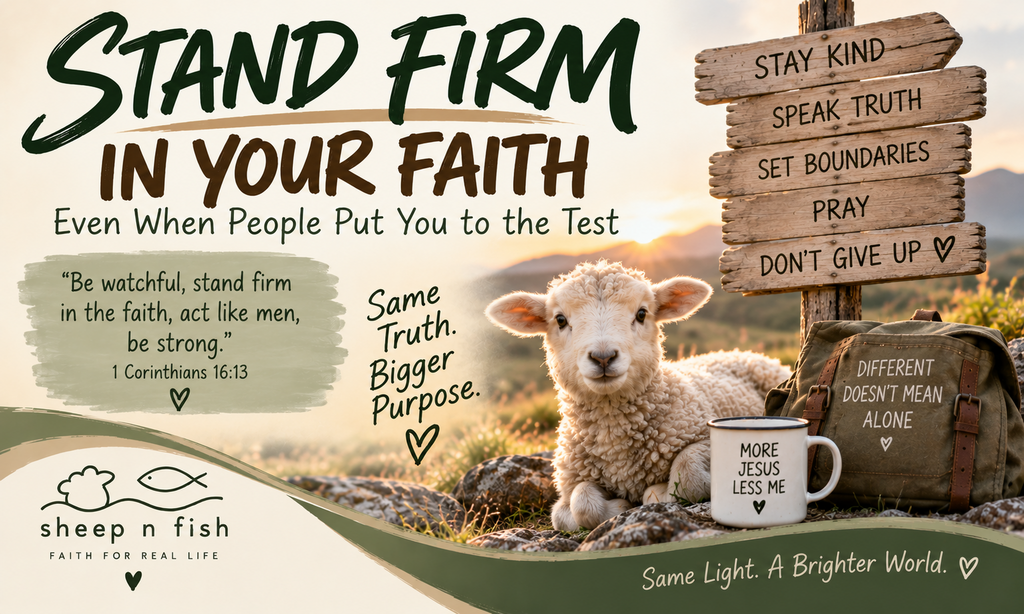
First Corinthians 16:13 says, “Be watchful, stand firm in the faith, act like men, be strong.” Standing firm does not mean we have to win every argument. It does not mean yelling louder, getting angry, or typing a 14-paragraph Facebook response at two in the morning. Sometimes standing firm simply means refusing to move away from what you know is true. Jesus warned us that following Him would not always make us popular. In John 15:18, Jesus said, “If the world hates you, know that it has hated me before it hated you.” That does not mean everyone who disagrees with us hates us. People are allowed to disagree, ask hard questions, and believe something completely different. Our job is not to attack them. Our job is to remain faithful to Jesus.
First Peter 3:15 tells us to be ready to explain the hope we have, but it also tells us to do it with gentleness and respect. That last part matters. If someone says, “I cannot believe you actually believe that Bible stuff,” you do not have to turn into a theological ninja. You can simply say, “Yes, I believe in Jesus, and my faith is important to me.” That is standing firm. Maybe someone at work keeps making jokes about your faith. You can calmly say, “I respect that you believe differently, but I would appreciate the same respect for my beliefs.” You do not have to be rude to be bold.
Social media can make this even harder because everybody has a microphone now, including people who probably needed a snack and a nap before they started typing. Someone may insult you, twist your words, or try to pull you into an argument. But you do not have to attend every argument you are invited to. Proverbs 15:1 says, “A soft answer turns away wrath, but a harsh word stirs up anger.” Sometimes your strongest response is a kind answer, and sometimes your strongest response is no answer at all.
Standing firm also means remembering who the real enemy is. Ephesians 6:12 tells us that our struggle is not against flesh and blood. The coworker making comments is not your enemy. The family member who disagrees with you is not your enemy. Even the stranger leaving angry comments is not your enemy. They are people, and Jesus died for them too. When we remember that, it changes the way we respond. We can defend our faith without attacking another person. We can disagree without being disrespectful. We can say, “I believe this is true,” without treating someone badly because they do not believe the same thing.
If someone truly harasses you at work, threatens you, or repeatedly targets you because of your faith, standing firm does not mean silently accepting harmful behavior. You can set healthy boundaries, document what is happening, and use the proper workplace channels to deal with the situation. Faith does not require you to become someone’s verbal punching bag. At the same time, we have to guard our own hearts. We cannot allow someone else’s anger to turn us into angry people.
Romans 12:21 says, “Do not be overcome by evil, but overcome evil with good.” That may be one of the greatest challenges for Christians in today’s culture. We are called to stand firm without becoming hard, speak truth without becoming cruel, be bold without becoming arrogant, and love people without changing God’s truth just to make everyone comfortable.
The next time someone puts your faith to the test, stop before you react. Pray and ask the Holy Spirit for wisdom. Remember that you do not have to win every argument. Your greater goal is to represent Jesus well. Sometimes the strongest testimony is not what you say when your faith is being tested. It is how you act while it is being tested.